Summary
One of the questions we often hear from our initial conversations with clients is: "What is the return of investment (ROI) in innovation training with you?"
As we have seen for many years, to convince the top management to jump onboard this boat (or any other), we need to prove that it is economically viable, so that means we need numbers!

Training Specialist at Ninety, delivering training to Ninety's clients. Saray has a background in HR, facilitation, consulting and social innovation.
But, when it comes to innovation, it’s not as simple as that. I always like to view the ROI on innovation as more like investing in health cover; not health cover to be used when you are already sick, but one that helps you withstand sickness and gives you the necessary nourishment to keep your immune system strong and healthy and ready to tackle adversities as well as new challenges.
According to a recent report shared by BCG on Most innovative companies during 2021, (BCG’s) “…too few companies are ready to drive real value from their innovation investments”. The Covid-19 crisis meant that in 2020 companies had to rapidly adapt and innovation quickly ascended the list of top management priorities.
The survey shows that 75% of executives (10% more than previous years) are reporting that innovation is now a top 3 priority in their companies. This reflects a clear shift from previously considering innovation as a hard skill to increasingly thinking instead that it is a soft skill that all employees and companies need to be able to succeed:
Innovation is a MINDSET!
If we consider the average company lifespan on The S&P 500 index (in years), sadly companies are dying faster than ever…
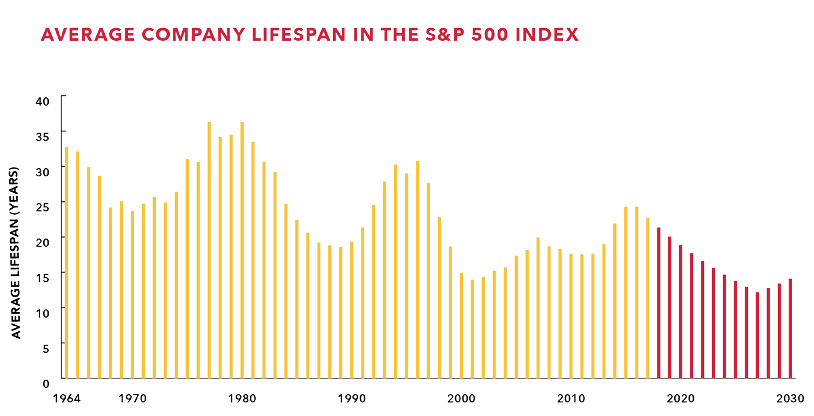
Looking at the chart, we can see the average lifespan has declined from 32 years to a maximum of 15. Quite an unsettling fact, right?
Optimistically, though, we are now on the path of realisation: Innovation is a must if top management wants their companies and teams to keep running in a strong, healthy and progressive way to last long into the future.
When talking with my colleagues who work in Human Resources and Learning and Development in their respective companies, we agree that we could measure innovation investment using KPIs – such as promotion rate, improvement in participants’ performance from the managers’ perspective, rotation of human capital inside the company, number of high achievers, and NPS (Net Promoter Score) – which would lead us to financial results for the specific department who had completed the innovation training, but is this enough? Where in those results would you see the benefits to the rest of the organisation for training all employees on how to be innovative?
All the metrics mentioned above are the ones that have served us until now. However, since innovation is clearly shifting into being a soft skill, it is time to turn the metrics upside down with a better focus on innovation’s impact – and not only from an economic perspective.
Innovation is a Mindset!
So then, coming back to our main question, “What is the value of investing in innovation training?”, we can answer considering the following three lenses:
Ideas generated: Witnessing an increasing number of ideas is crucial for measuring our success; not only the number of ideas generated during our training sessions, but also including ones submitted after the training is completed. We’re also seeing a marked improvement in the diversity and quality of the ideas generated. With better articulation of the issues being tackled, these ideas are going all the way to solving the problems; offering solutions and generating value for the organisation and its clients. As a mantra of innovation, we always remind our trainees to “fall in love with the problem, not the solution”. Ideas generated vs ideas executed is a good ROI measurement to maintain continued leadership support.
Ideas executed: With innovation training, employees will be better able to navigate the possible obstacles to innovation and therefore they will be more likely to be successful in moving forward with their idea implementation. An increase in these 2 first points are a very good indicator of the value invested.
Employee skills and network: Overall improvement in employee skills makes for a much more effective network! As we like to remind our clients, innovation is a team sport; having the right people in the room makes a big difference to how the creation, and indeed execution, of an idea will evolve. Different sets of skills, backgrounds and perspectives are vital for innovation to happen, with a higher chance of successful outcomes if it involves a cross-section of the organisation’s employees, not just the ones from the ‘innovation department’. Our clients and training participants have regularly highlighted to us the benefits of cross-functional innovation training in this way: promoting cognitive collaboration, as it does, between teams and generally strengthening relations among employees, which links to our next point.
Impact on the organisation’s culture: Personally, this is an important one; to feel happy as an employee for being part of an organisation is not the same as feeling engaged. One of the things we commonly see in our training sessions is that the level of engagement from our trainees within their own companies increases.
Our training in innovation not only helps people learn about innovation but it grows their confidence and naturally leads on to them becoming advocates or champions inside their organisations. Their feeling of belonging – and contributing – leads to increases in productivity as well as the value they bring to the organisation. Referring to the KPIs above, this engagement can be reflected in lower numbers of people leaving the organisation, and an increase in candidates attracted to work there.
These are just a few things to consider when looking at the value of investment in innovation training. Our ways of working involve setting up an Innovation Mindset among the teams and the organisation’s leadership. We enable our participants to become advocates of innovation inside their organisations, allowing them to change the internal culture as people embody innovation within their roles but also in their individual state of mind. Planting the seed of innovation may not have an immediate outcome, but, as with nature, time can bring us beautiful results (and those can’t always be measured in £s).
Ninety partners with insurance organisations to teach everyone the skills to innovate. If this article has resonated with you, and you’d like to explore things further, please do get in touch; we would welcome the opportunity to talk to you.